Showing posts with label series. Show all posts

Monday, March 18, 2013

Finally in Universal Class: Hobbies, Writing, and Legal Issues

Genealogy 101 Cake Decorating 101
Images from Universal Class

So far I have been focusing on what the library's subscription to Universal Class has to offer businesses, students, employees, and individuals concerned about health.  This week is all about fun.  Perhaps your hobby is listed below. If not, no worries; dozens more are listed here.  Please read this post about how to sign up for Universal Class.

Dog  Training
Bird Watching

Card Games


Babysitting
Sewing 101

Pie Baking 101

Candle Making

Genealogy 101

Feng Shui 101

Introduction to Gardening
Introduction to Music Appreciation
Journaling and Memoir Writing 101
Photography 101
Poetry Writing 101

Wedding Crafts and Projects
Wedding Planning 101

And this wraps up my series of  posts exploring the free-to-you classes available through your public library's homepage.  Thanks for sticking with me!

Monday, March 4, 2013

Also in Universal Class:Education (GED or Home schooling)

Remember Daylight Savings Time begins next Sunday, March 10.  The clocks "spring" forward one hour.


How to Teach Reading Fundamentals Algebra 101: Beginner to Intermediate LevelChemistry 101 Legal Secretary 101
Images from Universal Class

While the name Universal Class tries to express itself fully, today's blogpost digs into the school-age focused options, simply to clarify.  Some of the courses are designed to involve both parents and children or teachers and students, rather than ask kids to enroll and work online directly.  Some courses are targeted at older students or non-traditional students approaching the GED from many different levels of experience.

You are welcome to try any class; age is no object.  Whether your interest or need is for science, mathematics, grammar, history, or another language, I hope you find something useful.  This is not the complete list, by far; peruse other options here.

ABCs of Algebra
Algebra 101
Basic Math 101
ABCs of Geometry

ABCs of English Grammar
English Composition
Basic Research Skills
Essay Writing 101

ABCs of Physics
Biology 101
Astronomy 101
Chemistry 101

Geography 101
American Civil War 101
American Revolutionary War 101
American Government
American History Review
Ancient Civilizations 101
Economics 101
Economics 201

Computer Basics 101

ESL Basic Grammar
ESL Basic Writing Skills

First Grade Curriculum 101
Second Grade Curriculum 101
Third Grade Curriculum 101

GED Test Preparation

Monday, February 11, 2013

More in Universal Class: Health

Maybe you visited the Village's health fair last month?  The library had a table loaded with flyers and posters and bookmarks on the different ways the library can help you understand and explore health issues.  If you didn't, this blogpost is an excellent alternative because much of the same material is below.  As a library, we are not health experts and cannot advise.  We can connect you with the county health office [575-258-3252], the state's nursing hotline [ 1(877) 725-2552], or other reliable sources of information.  As with legal questions, please visit us at the library and let us know if you would like a little more privacy (such as the Archive Room) to ask your questions, or reach out to us through email.

Outside of the articles, nursing specific, and direct-from-the-government's National Institute of Health tutorials, videos, FAQs, and guides, the library provides you access to classes to explore health topics, too.  As mentioned in earlier posts, these classes are free to you, start whenever you are ready, and go as fast or slow as you need.  There may be videos to watch or text to read online (or print and keep for later reference).  The instructor may suggest other sites for further exploration and assignments to help you apply the new knowledge.

This is a list of the more health-focused courses among the 500 available.  Each is a link to open the course (you will need your library barcode number and your email to create an account in order to start).


Reiki 1st and 2nd Degree


Monday, January 21, 2013

Do you ask the BIG questions? Plus some timely announcements at the bottom

[Edit note: class links below are now correct and lead to Ruidoso Public Library's subscription so you may take the classes on us.]
© Nevit Dilmen [CC-BY-SA-3.0  or GFDL ], via Wikimedia Commons
If you are interested in exploring questions of a religious or philosophical nature, the library is a great place to start.  Beyond the books or DVDs we can loan you, we have several self-paced online courses, free for you to fit into your schedule, 24/7. Whether your preference is New Age or Biblical, experiential or logical, there's at least one course that might interest you.
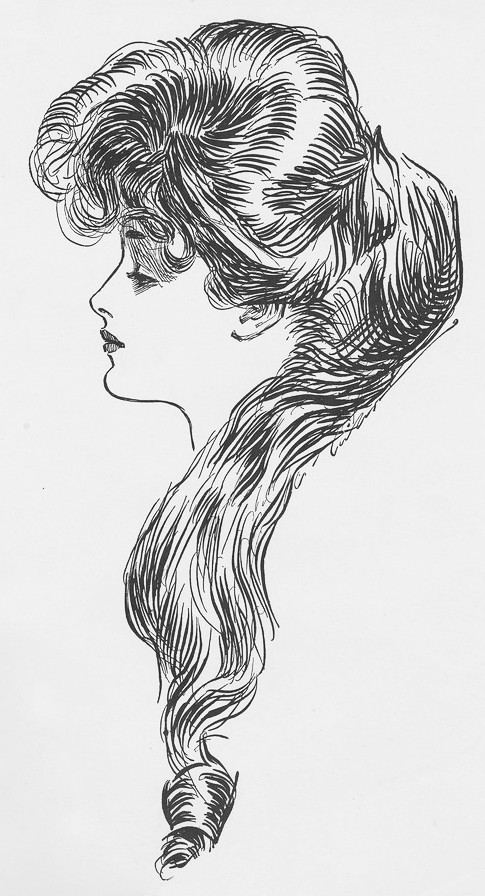
Woman's pompadour looks like question mark
By Charles Dana Gibson [Public domain], via Wikimedia Commons

As with the business courses, there is an entry class on how to take online courses for novices which teaches you about email, adding an attachment, commenting on another's post, etc.  You may have several friends to share with and might want to request the conference room at the library to watch, learn, and discuss the materials together.  If so, please email, call, or stop in at your convenience; we'd love to hear from you.  Sharon and Jennifer have tried some of these online classes, if you want to talk about specific features of the process or material.

Here's the long list of possible topics:

Philosophy 101           

P.S. If you heard about the JAVA update that led to a security problem January 12, some updates are available.  For directions on how to uninstall older versions of JAVA and where to install the current patch (JAVA 7 update 11)

P.P.S. If you missed the movie, Forks Over Knives, last Tuesday, you can still catch the flick (online at hulu for free or by checking out the DVD at the library) and read some analysis of the science here.

P.P.S. The library is closed today, Monday, January 21.  We will open tomorrow at 9 am.

Monday, January 14, 2013

Do you run a business? Or think about it?

[Edit note: on January 30, 2013, I edited all the class links in the bottom list to open inside the Ruidoso Public Library's subscription so you can get the free access with your library card number now. My apologies.]

Ruidoso Public Library is full of resources specifically selected for a community like Ruidoso or Lincoln County, where new businesses, small business, home-based or online businesses are the heart of our economy.  Whether you are an employee, the manager, or an owner, the library has *Free* classes that you can take at your convenience.  The next several posts will explore different sets of courses, including health, homeschooling or GED preparation, New Age/Spiritual/Religious Studies, Writing, Law/Legal, and many different hobbies.  Over 500 courses are available, and I won't describe them all, but if something takes your fancy, feel free to stop by the library for assistance, if the links don't work, or to let us know about a subject that is missing.

Before I list courses, I will try to explain how this works.  The library subscribes to Universal Class so you may log in with your library card number, for free, anytime, day or night, any day of the week.  If you have not done much online, one of the first things to do is learn how to take an online class.  These courses have videos to watch and listen to, or just read the text articles/lectures.  Each section may take from 15 minutes to an hour, depending on how new the material is for you, and how many of the supplemental links you explore.  There are assignments, quizzes, and exams, which are graded.  At the end, there is a document you may print or email as proof of the time you spent.

Search for a company, type of business, etc.

What does this mean for you?  As an employee, it might help you feel more confident making phone calls or facing difficult customer situations.  As a manager, assigning a course might help you provide employee development or address a specific safety concern.  Maybe you are desperate for a pay raise, but need some strong evidence to prove how you are applying yourself in ways to help the company.  These courses require the self-discipline to apply yourself, but you can do all the segments at once, or spread out over days and weeks (up to six months).  Outside of your time, they are free.  And if you don't have the home computer/internet thing yet, you are welcome to use the public stations at the library.  This is a slow time of year and we can help you get started on the computers, though you do need an email address to create your Universal Class account.  If enough people comment below, or call the library, I can look into a class on creating your first email account, too.

Over 500 online courses to learn on your own time


For employees looking to improve their resumé or support a request for an increase in pay:
Interview Skills
Customer Service
Personal Protective Equipment
Work Place Safety
Waiter or Waitress Training
Telephone Skills and Quality Customer Service

For managers' skill sets:
Payroll Fundamentals
Marketing for Small Business
Employment Law Fundamentals
Personal Protective Equipment
Work Place Safety
Worker's Compensation
Understanding Business Administration 101

For business starters/owners:
Small Business Guide
Pet Sitting
Home Business Guide
Daycare
Start a Concierge Service

Of interest to all types:
Sexual Harrassment Compliance
Bookkeeping and Accounting for all
Accounts Payable Management
Accounts Receivable Management
Anger Management
Assertiveness Training
Confidence Building
Negotiation Skills
Dealing with Difficult People
Retail Business 101
Creating an Effective Sales Team

Monday, November 26, 2012

What else is hiding in the home page?


About Us, Contact Us, and e-Branch

Home, Calendar, Library News, Research, Children's Library, Teen Scene, About Us, Contact Us, e-Branch
The bar of tabs on the homepage
The last tabs, but not the least, are "About Us" and "Contact Us."  The first has information about the Friends of the Library, FAQs, a history of the library, and a list of the services available through your library card.  The second lists email addresses for library staff, the library board members, and a map to find our building.

Finally, to wrap up this series of posts on the library's homepage links: the e-Branch tab.  Big libraries are developing a whole branch in the electronic realm (like the neighborhood branch libraries in a system, but available in any location).  This is our first attempt at consolidating the electronic services Ruidoso Public Library offers.

Moving the mouse over the e-Branch tab displays a menu list of resources:
Universal Class
Overdrive
Magazines and Chilton's Auto
Genealogy
NM Newspapers
Opposing Viewpoints
My Account

Clicking on the tab opens a new page displaying "widgets" leading to several of these destinations.  A widget works like a button--clicking on it opens that item.  Some request you enter your library card number before opening the site; others may request that information in order to check out materials.

Universal Class offers 500 certified continuing education courses--start it when you are ready (today if you like) and take up to six months to complete the lessons (graded by a professor).  Work with other students online or alone.

Overdrive provides ebooks and audiobooks to download on your computer, Kindle, nook, iPad, ipod, smartphone or mp3 player (among other devices).  Like library books, they are free to check out for a week or two.

Magazines and Chilton's Auto connects you with hundreds, if not thousands, of magazines, journals, and encyclopedia.  While the library is not open 24/7, these resources are, so check here first when you have to research a paper or need to fix your car.

Genealogy opens Heritage Quest, one of the sites for looking up your family tree from home.

NM Newspapers connects you with the Albuquerque Journal, the Las Cruces Sun-News, and the Roswell Daily Record.  It is not as easy to browse as the print copy, but if you have a title or page number, you can find most of the paper's articles that day or since 1995 (ABQJ), 2002 (Roswell), and 2004 (Sun-News).  Twenty-two magazines are also available, digitally, such as Field & Stream, Foreign Affairs, Slate, or Parenting.

My Account allows you to log into your library account and renew your current loans or request a turn with a popular title.  To set your PIN, please visit us in person.  This is the same PIN used to access Overdrive ebooks.

Monday, October 8, 2012

Part 10: Making Sense in the Stacks, 000s


What could be left to classify after nine weeks?  This is the section that covers all the gaps, called the Generalities, 000s.

UFO Sightings Chart

This section covers UFOs (001.942), computers (004-006, whether it's a program/software, hardware/devices, or the history of computing), library and information science (gratuitous plug for my favorite subject, 020s), and journalism (070).  Encyclopedias hang out here along with books about books--which ones to read, bibliophiles, or books about old manuscripts.  Then we reach the "generalities," the books that did not belong anywhere else, such as Robert's Rules of Order, books on the Bermuda Triangle or Atlantis, or guides on how to get published.  This is also the place for quote books for all occassions, oxymoronica, and guides to the iPad, the Internet, or Windows 7.
Book Jacket

You may be curious why there are no books in the some number ranges.  When Dewey began his system, 140 years ago, he knew he might miss some fields at his library that might hold many shelves at another library.  So he left several sets of numbers empty.  Many have filled in the past decades, but several remain unassigned.  For a complete listing of which numbers are still blank and exactly what topic fits in what number, check out the list at Wikipedia.

In addition, each library has some discretion as to where to classify a book or where to display them. For example, biographies may be found in 921-928 or in 040s, but Ruidoso Public Library consolidates all biographies on one wall with the number "92" on the spine label, then the subject's last name.

Monday, October 1, 2012

Part 9: Making Sense in the Stacks, 100s

Philosophy and Psychology

What do you see?

Rorschach1
Rorschach at Wikimedia Commons
The 100s in the Dewey Decimal System have the honor of the primary place in education at Amherst College in Massachusetts in the second half of the nineteenth century.  The top field of scholarship in a Classical education was philosophy, ranging from Metaphysics (110s) and Paranormal phenomena (130s) to Logic (260s) and Ethics (170s).

As a student, I am often confused by morals and ethics.  It turns out Ethics means the study of morals and morals are the "rules or habits of conduct...with reference to standards of right and wrong." That may explain why Ethics is also called "moral philosophy."

Even though Paranormal phenomena are found in the 130s, the books on UFOs are in 001.942, which will be explained further next week.  Perhaps the two fields surrounding the 130s will shed some light on what to find here.  The 120s cover epistemology, causation, and humankind.  The 140s look at specific schools of philosophy, such as Transcendentalists; however, ancient, medieval, and oriental philosophies (Plato or Confucius) are in the 180s and modern western philosophies (Nietzsche or Rand) are in the 190s.

If Psychology is more your interest, check the 150s.

Sigmund freud um 1905
Sigmund Freud at Wikimedia Commons

Monday, September 24, 2012

Part 8: Making Sense in the Stacks, 200s

Enter the world of the 200s, the world of Religion.

☪☮\✡i☯✞

This is one section in the Dewey Decimal System that really shows its origins in Amherst, Massachussetts, 140 years ago.  Sections 200 through 259, and 270 through 289, look at Christianity specifically.  That does not leave much room for Social and Ecclesiastical Theology (260s) or Comparative Religion and Other Religions (290s), where everything else finds a home.

Red and white striped brick cathedral in London
Westminster Cathedral (cue Beatles)


Works specifically on, or versions of, the Bible are 220s.  Christianity and theology can be found in the 230s.  Christian moral and devotional theology are in the 240s.  The 250s cover Christian orders and local churches, while the history of Christianity and Christian Churches are in the 270s.  Christian denominations and sects are lumped together in the 280s, including the Church of Latter Day Saints, and Hutterites.  The classes 200 through 219 are slightly more open for all religions or the philosophy and theory of religion.

The extensive 290s include:
Greek Mythology
Thich Nhat Hanh,
the Dalai Lama,
Carlos Casteñada,
Native American traditions,
A Course in Miracles,
Joseph Campbell,
Buddhism,
Hinduism,
Judaism,
Islam,
and Scientology.

Greek - Herakles and the Erymanthian Boar - Walters 48253 - Detail A
Herakles and the Erymanthian Boar at Walters Art Museum

P.S.: Join Jennifer at the library for another chance to explore a technology petting zoo or learn about ebooks on your Kindle, smartphone, or iPad on Tuesday, Sept 25 at 10 am.

Monday, September 17, 2012

Part 7: Making Sense in the Stacks, 300s


Welcome to the 300s (no, not the movie about the Spartans)

Social Sciences are covered in the 300s, which means, if it's drug, sex, or violence, look here.
Book Jacket   Book Jacket  Book Jacket

In drugs, the legislation, study of hippies or beatniks, social problems, or statistics are gathered in 300s, but the chemistry and medical uses are in 540s and 610s.

The 300s cover sexuality, including court case history, social problems, and social services.

And violence makes several appearances, from true crime (364.152), to The Confessions of an Economic Hitman (330s); from military science (350s) to Brothers Grimm fairy tales (398.2).
Book Jacket

The 300s are not just fun and games.  This is also the place to find legal guides (340s: how to write a will, file a divorce), career advice and guides (331), financial advice (332.024), or secondary education information.  Education, 370s, ranges from exam (SAT, ACT, GED) preparation, to homeschooling guides, from college selection to scholarship guides. Of course, Dewey is never that simple: athletic scholarship information is actually in 796.

Some other favorites in the 300s:
General social sciences at 301: Book Jacket
Espionage and intelligence secrets 327: Book Jacket

Commerce, Communications, and Transportation 380s: Book Jacket

Costumes, Customs, and Etiquette 390s:Book Jacket
However, etiquette for exes is under 641.


This week's service announcement: Music Film festival. Movies at noon every day through September 26. And live, local music Thursday night at 6pm.


Monday, September 10, 2012

Part 6: Making Sense of the Stacks, 400s

Hooray, we made it to the 400s: Languages

If you are looking for where "hooray" came from, its etymology, would be in the 400s.  Linguistics (the science of language and speech) starts at 401, and runs through American Sign Language books at 419.
Book Jacket
English dictionaries, grammars (not to be confused with style guides in 800), learning English as a Second Language, and the history of the English language starts in the 420s.
Book Jacket                                    Book Jacket

As in the 900s (Geography), we take the same crazy path around the world for languages: 430s for German, 440s for French, 450s for Italian and several Eastern European, 460s for Spanish and Portuguese, 470s for Latin, 480s for Greek, and 490s for everything else (i.e. Apache, Russian, Egyptian hieroglyphics).  Please remember, the 400s will house the dictionaries and how-to books for English speakers to learn, study, or translate these languages, but literature in these languages is found in the 800s (such as Don Quixote or The Odyssey).  Why do Latin and Greek each get 10 places, while everything else is wedged into 490s?  Because Melvil Dewey worked at one college's (Amherst) library and their curriculum, which focused heavily on Classics.

Book Jacket

Some fun facts in the 400s: Simon Winchester (whom I have raved about before) has two books on the origin and history of the Oxford English Dictionary.  If you, like me enjoy playing with words, Eats, Shoots & Leaves is also in this section.

Book Jacket

Ruidoso Public Library has several types of Spanish dictionaries: European, Mexican, New Mexican and Southern Colorado, Latin American, street-wise, and medical, too!  Our collections stretches as far as handwritten Japanese, Korean, Mayan glyphs, and Sanskrit.

Speaking of dictionaries, crossword puzzle dictionaries are not in the 400s; find them in the 793s, with the other puzzle books.

Tuesday, September 4, 2012

Part 5: Making Sense of the Stacks, 500s

FYI: Pre-school Story Times resume this week: Wednesdays 10:30 am to 11:15 am.
And New Mexico Legal Aid is available Sept 5 at the Ruidoso Senior Center, from 10 am to 2:30pm, on a first-come basis with a lunch hour at noon.  For more information, please call 1-866-416-1920.  They will help with Social Security, Landlord/tenant, TANF, or unemployment denials.  New Mexico Legal Aid will assess every case for free but cannot guarantee representation.

500s: Natural Sciences & Mathematics

As mentioned last week, topics are squirrelly in the 500s and 600s. If I want a book on squirrels, do I look in 590s for wild animals, 630s for pets, 640s for recipes, or 790s for hunting?

I have mentioned this book before, but it is an example of the primary subject matter putting a book in a different location.  The Crack in the Edge of the World is a history about San Francisco's geology.  The history part explains its location at 979.461, even though the geology topic might lead you to look for it in 550s, Earth Sciences, or the San Francisco topic might suggest 917.94.
Book Jacket


If you are interested in brushing up your math skills, the 510s have several titles to practice or introduce math concepts, i.e. Calculus.  However, if you are focused on the PSATs, SATs, ACTs, GED, or GRE, these test preparation books are in 378.
 Book Jacket

If you are looking for books to explore the night sky's constellations or meteor showers, check 520s.

Book Jacket

If you are ready to ponder the Big Bang, String Theory, or why the sky is blue, join Stephen Hawking and Brian Greene in Physics, 530s.
Book jacket

When I searched the catalog for Chemistry, the results included a 150 on the psychology of fearing modern chemicals, a 612 for the prescriptions that might make us smarter, and a 644 on the chemistry of sugar in modern American diets.  Luckily, AP Chemistry and an Oxford dictionary on chemicals are waiting in the 540s.
Book Jacket
Tim Flannery introduced me to the history of Australia.  Here at Ruidoso Public Library, he shares Earth's natural history in the 550s. 
Book Jacket

 Lucy, the book on Australopithecus, is then in the 560s, also known as Paleontology.
Book Jacket
Biology and Life sciences are in the 570s, so find Charles Darwin here.
Book Jacket

Plants (in nature, not your garden) are in the 580s.
Book Jacket

And finally, animals (again, in nature, not on the farm or in your pocket) are in the 590s, including insects.
Book Jacket                                    Book Jacket

How are these posts doing?  Am I helping at all?  Let me know if you prefer the earlier format with fewer pictures or have other suggestions to improve the second half of this series.  Thank you, dear readers!


Monday, August 27, 2012

Part 4: Making Sense of the Stacks, 600s

Just a reminder: Ruidoso Public Library will be closed Saturday through Monday, September 1st through 3rd, in observance of Labor Day.  We will re-open Tuesday, September 4, at 9 am.

600s: Applied Sciences and Technology

This week and next week are extra tricky as we explore 500s (Natural Sciences) and 600s (Applied Sciences).  Why?  Horses pop up in 590s (wild) and 630s (farming)---and, if you recall from last week, 798 for equitation and racing.  Engineers (620s) might need mathematics (510s), physics (530s), or buildings (690s), if not architecture (720s).  Gardeners might look through the 590s for animals in your garden, 580s for botany and wild plants, and 635 for horticulture and gardening.

How to keep them straight?  If it is a natural science, especially the theory of math or a science, go with 500s; if it is used or does something, try the 600s.

Here is a roadmap of Applied Sciences and Technology:
610s: Medicine (including diets, exercise plans, or specific symptoms/ailments)
Book Jacket

620s: Engineering (including guns, automotive repair manuals, wind generators, RV maintenance, or knots)
Book Jacket

630s: Agriculture (farming, raising livestock, gardens, dogs and other pets)
Book Jacket
640s: Home Economics (sustainable/off-grid living, cookbooks, laundry and housekeeping tricks, personal beauty/hygiene)
Book Jacket
650s: Management (Resumés or Cover Letters, Business plans, time management, self-help, bookkeeping, eBay, advertising)
Book Jacket
660s: Chemical Engineering (or fun projects such as wine-making, home-brewing, soapmaking, household cleaner alternatives)
Book Jacket
670s: Manufacturing (papermaking, woodworking, or tanning leather)
Book Jacket
680s: Specific Manufacturing (gunsmithing, furniture construction, cabinetry, teddy bears and dolls)
Book Jacket

690s: Buildings (drywalling, plumbing, adobe or straw-bale or frame construction, greenhouses, outbuildings, flooring, tile, and painting) 


Book Jacket